Placing mirrors either side of the panel to reflect doesn t work well because as the sun moves west it will cast a.
Increasing solar panel efficiency with mirrors.
At a current cost of 0 70 usd watt on the low end for low end solar panels it would potentially be cost effective for a large 200 watt panel 200 0 70 140 usd if the wholesale cost of the mirrors would only add up to 20 the cost so in this case 28 usd.
Factors that affect solar panel efficiency.
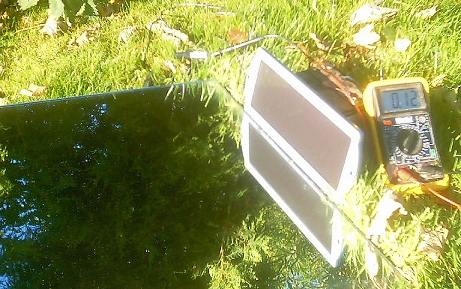
Was 24 watts and from solar panel with mirrors and cooling.
Output may be increased by perhaps 50.
You can use more mirrors to reflect more light onto the solar panel and increase it s power further but on a sunny.
Solar cell pv efficiency is not affected by increasing the intensity of light falling on the solar cells.
Solar panels have been consistently increasing in efficiency at about 5 annually since 2010.
The wavelength of light falling on the solar cells affects the efficiency of output and using mirrors does not affect the wave length of light and hence does not affect efficiency or output.
With that placement and standard panels the increase in generated solar electricity reached 45 percent.
Its fraction of incident solar energy converted to electricity remains the same.
Numerous features have been accommodated in the solar panel design to improve the efficiency of the solar panels.
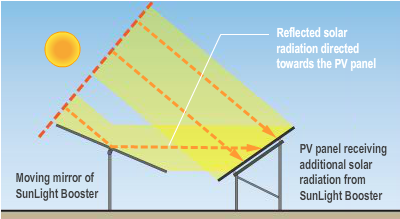
But adding mirrors or lenses to a pv system increases the area over which sunlight is collected so you do get more light onto the panel and thus more energy out of the expensive panel by adding relatively cheap mirrors or lenses.
On a dull day the mirror doesn t give much of a power boost at.
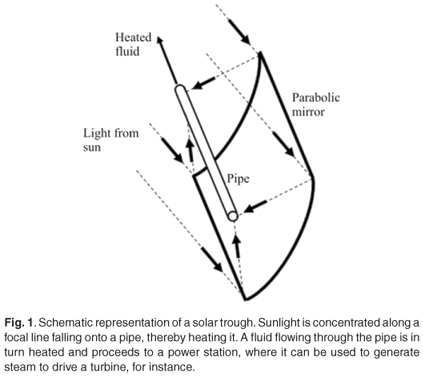
Solar panel output power may be increased via a light concentrator such as a fresnel lens or mirror.
Most of the advances in solar power production come from increasing the efficiency of the photovoltaic cells.
Also concentrators may not be practical for a large array and orientation of the mirror creates an additional tracking problem.
Even with a panel optimally tilted the efficiency increased by 18 percent and simulations show it could be pushed to 30 percent with better reflectors.
Even with a panel optimally tilted the efficiency increased by 18 percent and simulations.
The goal being to increase the watts produced per panel.
Increasing the yield through reflection could make that an even more affordable energy supply option.
The highest efficiency solar panels on the market today can reach almost 23 percent efficiency.
With that placement and standard panels the increase in generated solar electricity reached 45 percent.
The average efficiency of solar panels falls between the 17 to 19 percent efficiency range.